
Estepona: How a Working Town Became the Costa del Sol's Fastest-Growing Investment Market
For most of the last fifty years, Estepona was the place people drove through on the way to Marbella.
In June 2026 the average price of a home in the municipality reached 4,292 euros per square metre, up 11.6 per cent in a year. New build in the strongest pockets has passed seven thousand euros per square metre — a figure that would have been read as a typing error in this town five years ago. Estepona has now outgrown Marbella on percentage terms for four consecutive years.
This is not a lifestyle piece about a pretty town. It is an analysis of why the growth happened, which parts of Estepona are actually driving it, and what an investor should be cautious about at this stage of the cycle. The short version is that Estepona is a case study in something rarely visible in real time: what happens to property values when a municipality spends fifteen years deliberately rebuilding itself.
The Numbers
Estepona's price per square metre has risen roughly fifty per cent over recent years, and the annual rate has stayed in double digits while more established markets moderated. In 2024 the Ministry of Housing recorded a 20.4 per cent increase, the largest of any major municipality in Málaga province. Through the first half of 2026, completed transaction prices rose over nineteen per cent.
The comparison that matters to an investor is the gap. Estepona sits at around 4,292 euros per square metre. Marbella's Golden Mile was at 6,789 in early 2026, and Marbella's municipal average sits well above Estepona's. So Estepona is roughly a third cheaper than prime Marbella while growing faster.
That gap is the entire investment thesis, and it needs stating precisely, because it is frequently overstated. Estepona is not overtaking Marbella on price and is unlikely to. It is overtaking Marbella on growth rate — which is a different claim, and for a buyer with a five to ten year horizon, a considerably more useful one.
New build is where the repricing is most visible. Contemporary schemes in the best locations now transact between six and eight thousand euros per square metre, and around a quarter of all transactions in the municipality are new build, a far higher proportion than in Marbella, where land scarcity limits what can be delivered.
What Actually Caused It
Most explanations of Estepona's rise stop at "the town got nicer", which is true and explains nothing. The mechanism is more specific, and it is the part worth understanding because it is what makes the growth durable rather than cyclical.
From 2011 the municipality ran a sustained programme of civic investment, and it did so continuously for over a decade rather than in the stop-start pattern typical of Spanish local government. Around two hundred streets in the old town were pedestrianised and replanted. The Ruta de los Murales placed more than sixty large-scale artworks on residential buildings. The Orchidarium opened in 2015. Parque Central was created. And the coastal path was extended into a continuous boardwalk running the length of the municipality's twenty-one kilometres of coastline.
The investment principle at work here is simple and applies well beyond Estepona. Public realm improvements show up in property values with a lag of roughly three to five years, and they do not reverse. A pedestrianised street stays pedestrianised. A seafront boardwalk is not withdrawn in a downturn. Unlike a new hotel or a fashionable restaurant, civic infrastructure does not depend on any business continuing to trade.
What Estepona did was convert a working coastal town into a place where the public space is the amenity. That is why the price growth has been broad rather than confined to a few gated developments — the improvement applies to the whole town, so it lifted the whole town.
The Infrastructure Layer
Civic charm alone does not move a market from three thousand to seven thousand euros per square metre. The second layer is harder infrastructure, and this is the part that turned Estepona from a nice place to visit into a place people relocate to permanently.
More than twenty large-scale projects have been delivered or launched since 2020, including a hospital, schools, and expansion of the marina. That list matters more than it sounds. A hospital and a school change the buyer profile from second-home purchasers to full-time residents and families, and full-time residents are a structurally different demand base: they buy larger, they hold longer, and they are far less sensitive to the seasonal cycle that governs holiday-home markets.
It also changed who sells here. Once a municipality has the services to support permanent residence, it stops competing only on price with its neighbours and starts competing on substance.
Why the Developers Went West
The supply-side explanation is straightforward and is the reason this was always likely to happen somewhere.
Marbella and Benahavís are running out of developable land in their prime areas. What remains is expensive, fragmented and slow to permit. Estepona has both land and, by general acknowledgement in the industry, a more efficient planning process — which for a developer means shorter timelines, lower carrying costs and greater certainty.
So capital moved west, and it moved at scale. Individual schemes on the New Golden Mile now run to over a thousand homes across multiple phases. That concentration of new, professionally delivered product has done something important to the market: it has raised the quality benchmark. Buyers comparing a 2026 Estepona scheme with a 2006 Marbella apartment are not comparing towns. They are comparing build standards, energy performance, amenity provision and layout, and the newer product wins on all four.
The Four Estepona Markets
Treating Estepona as a single market is the most common analytical error. It behaves as four, with genuinely different pricing logic.
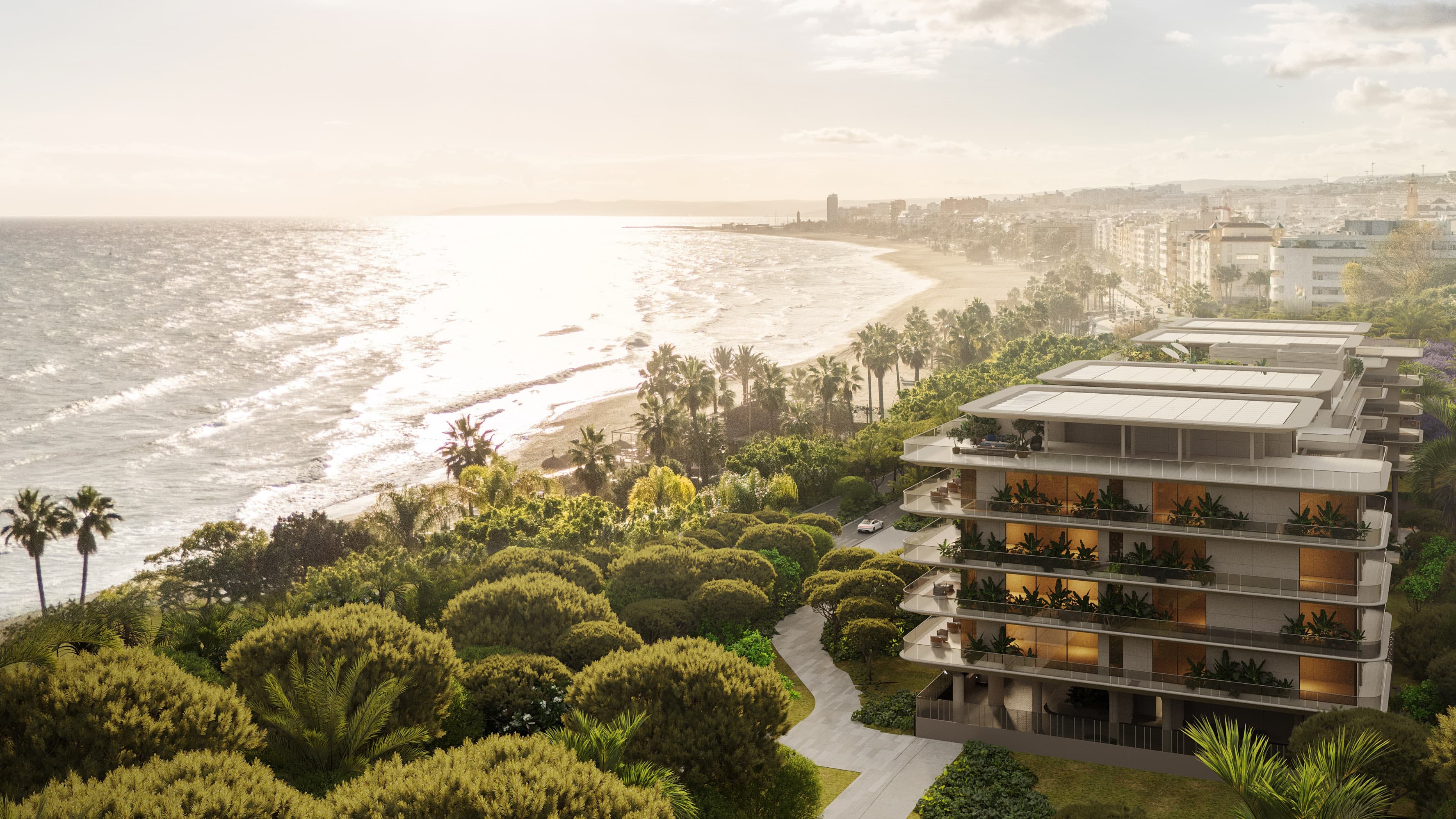
The New Golden Mile runs east towards Marbella and is the most internationally recognised sub-market. It is where the branded, resort-style schemes sit, where new-build pricing is highest, and where the strongest liquidity is. It is also the most competitive: the volume of new supply here is substantial, and a unit without a genuine differentiator — orientation, position within the scheme, a protected view — will compete against a great deal of similar stock at resale.
Las Mesas and the town approaches have moved fastest from a low base. Contemporary apartment schemes with marina views, within walking distance of the centre, appeal to buyers who want a real town rather than a resort. For an investor this is where the lifestyle proposition is strongest and the rental profile most year-round.
The Casco Antiguo, the pedestrianised old town, is the scarcity play. Prices here have climbed close to twenty per cent year-on-year, and the supply is fixed — you cannot build another old town. Stock is small, often needs work, and does not suit every buyer. But it is the only part of Estepona where supply cannot respond to demand, which over a long hold is the most reliable characteristic property can have.
West Estepona, towards Casares and Manilva, is where the remaining value gap is widest. Buyers historically discounted it for distance, and that perception has shifted as the town has become a destination in its own right rather than a suburb of Marbella. Entry pricing is materially lower, density is lower, and the product is modern. It carries more timing risk than the New Golden Mile, and correspondingly more upside.
Yield, Honestly
This is where an investment case should be careful, because the rental picture is less impressive than the capital picture.
Median gross rental yields in Estepona run at around 5.8 per cent, which is respectable by European standards. The district-level spread is wide, from under two per cent to nearly eleven, driven by property type, location and how actively the asset is managed.
The important trend is that rents have been broadly flat while prices have risen sharply. That means yields are compressing: a buyer entering today at 4,292 euros per square metre accepts a lower running return than someone who bought at a lower entry point two years ago. Short-term letting in the old town, the marina and the New Golden Mile achieves more, but requires active management, carries higher operating costs, and now sits inside a tighter regulatory framework for tourist rentals.
The honest conclusion is that Estepona is a capital appreciation market with a reasonable income underpin, not an income market. An investment case built primarily on yield is being built on the weaker half of the argument.
The Risks
Three, stated plainly.
Estepona is no longer early. Capital appreciation has averaged somewhere between eight and twelve per cent annually since 2021. That rate will moderate, and a sensible forward assumption is five to seven per cent rather than a continuation of the recent run. Anyone underwriting at double digits is extrapolating a catch-up phase that has largely happened.
Supply is the real variable. The same land availability that attracted developers means Estepona can respond to demand in a way Marbella cannot. Thousands of new homes are in delivery across the municipality. In a strong market that is absorbed comfortably. In a slower one, a generic apartment in a large scheme competes with the developer's own remaining stock, and the differentiated units — corner, top floor, protected view, walkable location — will be the ones that hold value.
The growth rate is not the price level. Estepona growing faster than Marbella does not make an Estepona property worth a Marbella price, and periods of rapid repricing produce some listings that have run ahead of what the market will actually pay. Achieved transaction evidence matters more here than asking prices, precisely because the market has moved so quickly.
Conclusion
Estepona is the clearest example on this coast of a thesis that is easy to state and hard to time: that sustained public investment in a place eventually shows up in what property there is worth, and that the effect is durable because civic infrastructure does not get withdrawn.
The town spent fifteen years rebuilding itself, added the hospitals, schools and marina capacity that turn visitors into residents, and offered developers the land and the planning efficiency that Marbella no longer can. The result is a municipality growing faster than its more famous neighbour while still trading around a third below it.
The window is narrower than it was in 2021, and the returns ahead will be more moderate than those behind. But the structural argument has not weakened. What has changed is that success in Estepona now depends on selecting the right sub-market and the right unit within it, rather than simply on being in Estepona at all.