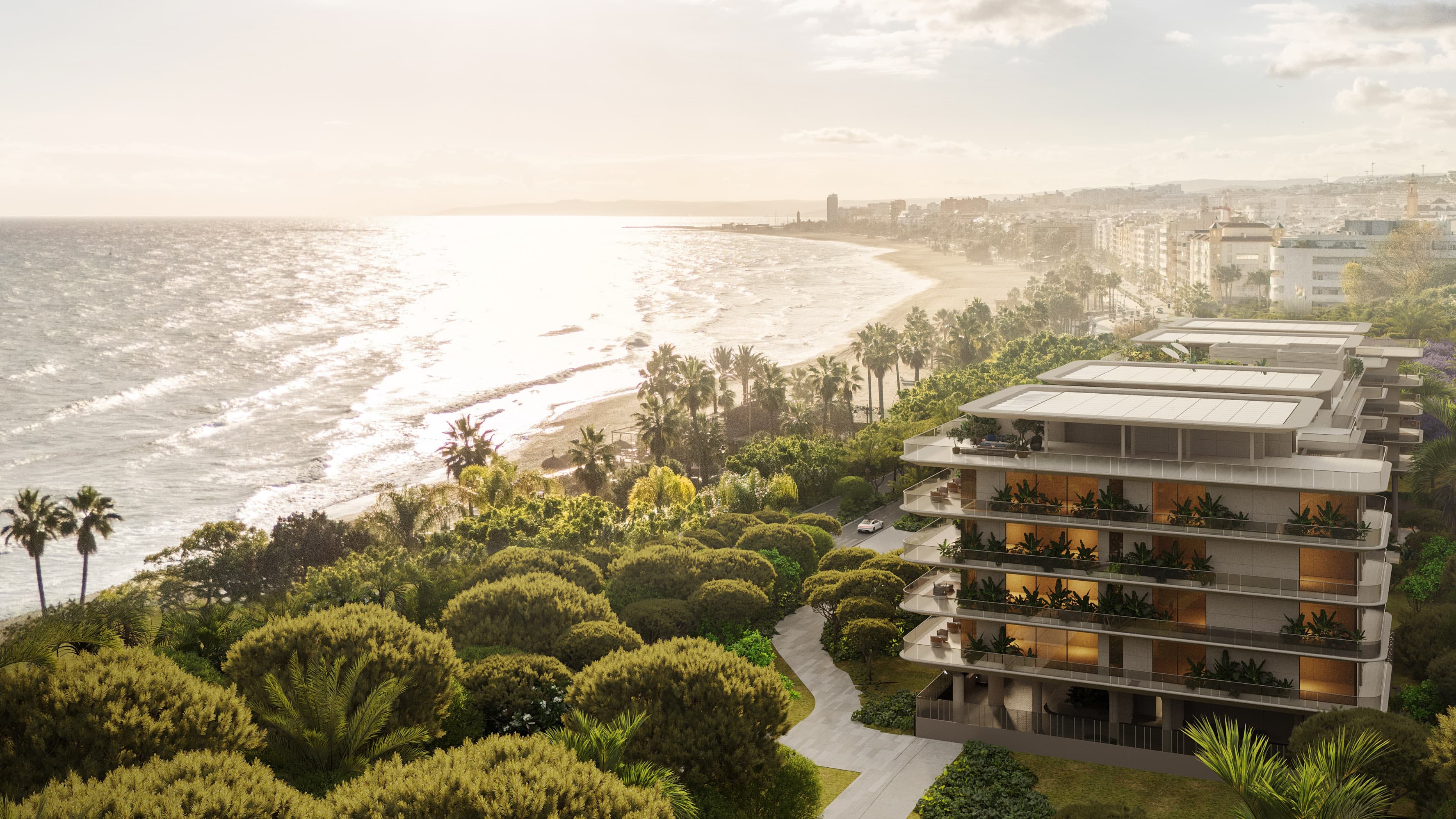

The 10 Questions I'd Ask Before Buying a New Development
A new development is the only property you can buy that does not yet exist. Everything you are shown is a promise — a render, a floorplan, a specification list, a delivery date. Most of the time those promises are kept. The difference between the buyers for whom they are kept and the buyers for whom they are not usually comes down to what was asked before the reservation was signed, not what was argued about afterwards.
Off-plan remains one of the most sensible ways into the Costa del Sol market. You buy at today's price and complete at tomorrow's, you spread the payments over eighteen months to three years instead of finding everything at once, you get a home built to current energy standards with a full set of legal warranties, and you can usually still influence the finishes. On the better schemes in Marbella, Estepona and Benahavís, values at completion have consistently exceeded launch prices.
But the protection you have as an off-plan buyer in Spain is genuinely strong — and it is strong only if it is actually in place. Spanish law does most of the heavy lifting here. What it cannot do is make you read the documents.
These are the ten questions we ask, in order, before we put a client into a scheme. None of them are difficult to answer. A good developer will answer all ten in a single meeting without hesitation. How they answer tells you as much as what they answer.
Common Questions
Start with the company behind the brand. Most Spanish developments are built through a project-specific company set up for that scheme alone. That is completely standard practice and not something to be wary of — but it does mean the reassurance you are looking for comes from the track record rather than the balance sheet. So ask what the same people have completed, and then go and look at it. Not the newest one. The one delivered three or four years ago, where you can see how it has held up. Walk the gardens, look at the communal areas, look at how the pool terrace has weathered. If you can, speak to the administrator of that community or to an owner, and ask the unglamorous questions: did it complete close to the date, was the snagging dealt with properly, has anything needed fixing since. The established Costa del Sol developers love this question. Several of the names building here today have twenty or thirty years of delivered schemes within a fifteen-minute drive, and they will happily point you at all of them. That is the answer you want.
This is the question people misunderstand most often, usually because they have read something written for a different market. Most of the best buying on the Costa del Sol happens at early release, ahead of the building licence being formally issued. That is not a shortcut or a risk to be avoided — it is simply how this coast works. A developer opens a limited number of units to a small group of buyers at the launch price, months before the public marketing begins. By the time the licence is granted, the show home opens and the scheme is advertised, the best-positioned units have gone and the price list has already moved. Buyers who wait for the fully licensed, fully marketed launch are buying the same homes later and dearer. The strongest gains our clients have made on off-plan have almost all come from early releases. What makes it work is the structure, and on a properly run scheme that structure is always the same. You reserve the unit with a modest deposit that is held in escrow — the agent's or a solicitor's client account — rather than going to the developer, on terms that define exactly when it is returned. Your lawyer then completes the due diligence, including the licence file at the town hall. The private purchase contract and the first substantial payment follow once the licence is granted, and from that point every payment you make is covered by an individual bank guarantee or insurance policy. Your money is protected at both stages, by two different mechanisms doing two different jobs. So the question is not whether the licence exists yet. It is where the project sits in the process, what the architect's expected timetable looks like, which account your reservation is held in and on what terms, and confirmation that the bank guarantee arrangement is in place for the contract stage. Those four answers are what turn an early release from a leap of faith into what it should be — the best-priced entry into the best schemes on the coast.
This is where Spanish law does the heavy lifting, and it is worth understanding properly because it is one of the strongest buyer protections anywhere in Europe. Under the Building Act, Ley 38/1999, as amended by Ley 20/2015, a developer taking payments before completion must cover every one of them with a bank guarantee or insurance policy, and must hold the funds in an account kept separate from its own finances. If the home is not delivered, you recover the full amount plus statutory interest running from the date of each individual payment. The 2015 reform went further still and made the bank holding the money jointly responsible for confirming the guarantees exist, so the depositary bank is a guardian of your funds rather than a passive account holder. The Supreme Court has consistently upheld that position in buyers' favour. In practice what you are asking for is simply the paperwork: the individual guarantee certificate for each payment, in your name, for that amount, from a named bank or insurer. On the schemes we work with that arrives as a matter of course — it is part of how a professional developer operates rather than a favour — and on an early release the guarantee arrangement is confirmed up front so it is in place when the contract is signed. Put the two stages together and the picture is a reassuring one. Your reservation sits in escrow while the diligence is done. Every payment from the private contract onwards is individually guaranteed and held in the project's special account. There is no point in the process at which your money is simply sitting with a developer, unsecured, which is precisely why off-plan works as well as it does here.
Ask for the memoria de calidades, the written specification, and go through it properly. Renders are illustrative and the furniture in them is rarely included, which everyone knows. The specification is the document that actually defines what you are buying, and on the better Costa del Sol schemes it is impressively detailed. Go through it at brand and model level. Which kitchen, which appliances, and whether they are all included. Air conditioning: ducted, throughout, heating as well as cooling. Underfloor heating in the bathrooms. Fitted wardrobes. Terrace flooring, exterior lighting, landscaping and irrigation to a private garden, pool heating on a villa. Home automation, and what that covers. One useful technical point: a parking space or storeroom deeded separately from the apartment carries 21 per cent VAT rather than the 10 per cent that applies to the home itself. Not a large sum, but it belongs in the budget rather than the surprise column. And ask for the upgrade list early. Choosing extras is far more enjoyable, and considerably cheaper, before the ceilings go in than after — which is one of the genuine pleasures of buying off-plan rather than finished.
A new build on the Costa del Sol carries 10 per cent VAT, applied to each stage payment as you make it, plus 1.2 per cent stamp duty in Andalucía, paid when the deed is signed at completion. That is 11.2 per cent in tax. Add notary, land registry and your independent lawyer, and the sensible planning figure is around 13 to 14 per cent above the purchase price. That is roughly four percentage points more than a resale, where transfer tax in Andalucía is a flat 7 per cent, and it is worth setting against what the extra buys: a ten-year structural warranty, current energy performance, no refurbishment, and payments spread across construction rather than due in one transaction. For most of our clients the maths comes out comfortably in favour of the new build. The second budget to set early is the one that gets the home ready to live in — furniture, window dressing, outdoor furniture, and on a villa, landscaping beyond the developer's scope. Many developers now offer a furniture package designed for the scheme, which on a second home is often the easiest money you will spend.
This is the question that most changes the outcome, and it is where an agent who knows the scheme is worth having. Two apartments in the same building, at the same price and specification, can be worth materially different amounts five years later. Orientation first. In Marbella, south and south-west take the afternoon and evening sun and hold value accordingly. Then position: which floor, what the sightline actually is from seated height on the terrace rather than standing at the balustrade, and how close you are to the pool, the padel court and the lift shaft — close is excellent for some buyers and not for others. Then the one worth asking every time: what is planned in front of you? Ask for the full masterplan with the heights of the later phases, and what the land beyond the boundary is zoned for. On a well-conceived development the answer is reassuring and the good views are protected by design, which is precisely the sort of thing that separates a considered scheme from an ordinary one. Knowing it lets you buy the unit whose view is permanent.
mings on the Costa del Sol are straightforward once you know how they firm up. At early release the delivery window is indicative, based on the architect's programme and the expected licence date. It becomes a contractual commitment at the private purchase contract, which is the document to read closely. Most schemes here run eighteen to thirty months from the start of works. So ask two things. What is the current expected handover window, and at what point does it become a date the developer is held to? Then, at contract stage, establish what circumstances allow an extension and how long it can run. A well-drafted contract defines those precisely rather than leaving them open, and the established developers are comfortable with that because they expect to deliver inside it. The same legal framework that protects your deposits also gives a buyer whose home is not delivered as contracted the right to rescind and recover payments with interest. It is a strong backstop, and one that is rarely needed here. Finally, ask about the licencia de primera ocupación, the first occupation licence — the town hall confirming that what was built matches what was licensed and that the home is ready to occupy. It is what connects the utilities, and completion follows once it is issued.
Community fees vary a great deal between schemes, and the driver is amenities. A development with a spa, gym, concierge, co-working space and extensive gardens costs more per square metre each month than a straightforward block around a pool. Neither is better — they suit different owners. What matters is knowing which you are buying, because the facilities that make a scheme a pleasure to own are also the ones you pay to run. For many of our clients the amenity-heavy scheme is exactly right: it is what makes a home you visit six times a year feel like a resort rather than a flat, and it is a significant part of why those units let and resell so well. Ask for the projected community budget, treat the first year as an opening estimate, and add IBI, rubbish collection, insurance, utilities and — for non-residents — the annual non-resident income tax on a second home.
Spanish new-build warranties are excellent, and they are one of the strongest arguments for buying new rather than resale. Ten years for structural defects, backed by a compulsory insurance policy known as the seguro decenal. Three years for habitability issues such as waterproofing, insulation and installations. One year for finishes. Two details worth knowing. Those periods run from the official handover of the works, the acta de recepción, rather than from the day you collect your keys. And the ten-year structural cover is an insurance policy rather than a promise, which is why it survives the project company being wound up after the final sale, and why it transfers to whoever buys the home from you. Before that comes the snagging inspection. Walk the finished home with someone who knows what to look for, agree the list in writing, and have it settled before the deed is signed. On a well-run scheme this is a short and cordial process, and it is a normal part of delivery rather than a confrontation.
The pattern on the Costa del Sol is consistent. A reservation deposit takes the unit off the market, typically six thousand to ten thousand euros on an apartment and more on a villa. Within roughly thirty days the private purchase contract is signed and a further payment brings you to somewhere between twenty and forty per cent of the price, with the higher end more common on prime schemes in Marbella and the Golden Mile where demand is strongest. Interim payments then follow at agreed points during construction, and the balance — usually sixty to seventy per cent — is paid at the notary when you complete. VAT is added to each payment as you make it.
So ask for the schedule in writing, with the trigger for each instalment. Ask whether the stages are tied to construction milestones or to calendar dates, because that affects when the money leaves your account if the programme moves. And ask whether there is any flexibility: developers will often discuss the weighting of the stages, particularly with a buyer taking a strong unit early in a release.
The practical value is that eighteen to thirty months of staged payments gives you time to arrange funds properly — moving currency in tranches rather than in one exposed transfer, and sorting a Spanish mortgage closer to completion rather than at the start, since the lending decision is made against the finished home.