
Mijas Costa: The Coast's Most Liveable Stretch
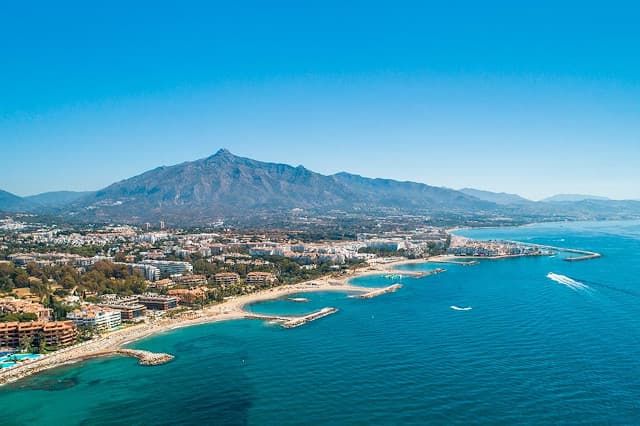
Twelve kilometres of coastline run between Fuengirola and the Marbella boundary, holding some of the best beaches in Málaga province, four golf courses, umbrella pine woodland that reaches almost to the sand, and a town in La Cala de Mijas that stays open all winter.
It is the part of the coast that people move to rather than holiday in. Less theatrical than Marbella, considerably greener than Fuengirola, and genuinely walkable in places where most of this coastline is not. This is a guide to the areas that matter — La Cala, El Chaparral, Calanova and La Cala Golf — and what daily life on this stretch is actually like.
Where It Is
Mijas Costa is the coastal third of a municipality that also climbs into the hills, where the white village of Mijas Pueblo sits at 430 metres with a view over the whole bay. The coastal strip runs west from Fuengirola to where Marbella begins at Cabopino.
Everything here is close to everything else. Málaga airport is about thirty minutes, with a rail link from neighbouring Fuengirola that runs to the terminal and on into the city — a genuine practical advantage that almost nothing further west can offer. Marbella is twenty minutes west, Puerto Banús twenty-five.
La Cala de Mijas
La Cala is the heart of it, and the reason so many people end up here rather than elsewhere on the coast.
It is a town rather than an urbanisation, which sounds like a small distinction and is not. There is a proper centre: a square, a church, a market, a promenade along the sand, and streets of restaurants and bars that stay open through January because they serve people who live here. Very few places on this coast can say that. Most empty out in October and reopen at Easter.
The result is somewhere with a real year-round community, drawing families, remote workers and retirees in roughly equal measure rather than depending on one group. La Cala has made the transition from fishing village to international town without losing its centre — the old core is still recognisably Andalusian, and the newer development has gone around it rather than through it.
It is also the best beach town on this part of the coast. The main beach is wide, clean and well serviced, the promenade runs in both directions, and you can walk from an apartment to dinner without touching a car. On the Costa del Sol that is genuinely rare.
El Chaparral
Between La Cala and Fuengirola, El Chaparral is the quiet answer for anyone who wants space and greenery.
The defining feature is the pine forest. Mature umbrella pines cover the hillside, the golf course runs down through them towards the sea, and the housing sits low-density among the trees rather than stacked along the coast road. The effect is closer to East Marbella than to the rest of this strip, and it is why El Chaparral holds a premium within the municipality.
The beaches beneath it are among the quietest and cleanest anywhere on the coast — small coves and open stretches with far fewer people than La Cala or Fuengirola, even in August. The golf club is well regarded and unpretentious. And the proximity to Fuengirola means shops, schools, the hospital and the railway are all a few minutes away without any of it being on your doorstep.
For buyers who want a Marbella-style environment — pines, privacy, space, a settled residential feel — without Marbella prices, this is usually where they land.
Calanova
Calanova sits just inland of La Cala around its own golf course, and it is the area most people drive past without noticing.
Elevated, green and low-density, with views across the fairways to the sea in one direction and the mountains in the other. It is minutes from La Cala's centre and minutes from the beach, but it feels entirely removed from both — quiet roads, generous spacing, and a community that is largely residential rather than seasonal.
The appeal is straightforward: golf-view living at a fraction of what the equivalent costs in Nueva Andalucía or Benahavís, with the practical benefit that the view cannot be built on and the landscaping is somebody else's responsibility. It has not been overbuilt, which is precisely why it has kept its character.
La Cala Golf
Behind the town, the hills hold La Cala Golf Resort — three courses, a hotel, a spa and a substantial residential community spread across a large estate.
It is a different proposition from the coast: cooler in summer, quieter year-round, and built around golf in a way that shapes the whole rhythm of the place. Residents here tend to play several times a week, and the resort's own facilities mean there is less need to drive down to the coast for everything.
It is also the most active development area in Mijas. A joint programme by FBD Leisure and Taylor Wimpey, worth in the region of 120 million euros, is targeting roughly a thousand homes across the resort over the coming years, with recent phases including apartments at Solana Village and the townhouses at The Meadows. For anyone wanting new build with resort infrastructure attached, this is the strongest option in the municipality.
The Rest of the Strip
East of La Cala, the coastal strip changes character. Calahonda is large, sprawling and built out through the 1980s and 1990s, spread along the A-7 in a way that makes a car essential. Riviera del Sol and Miraflores sit between the two, quieter and residential, with their own golf. Towards Fuengirola, Calaburra and El Faro occupy the headland.
These are convenient, well-established and generally cheaper, with a settled international population. They are not where the current momentum is, and buyers looking for the qualities that define Mijas Costa at its best — greenery, walkability, a year-round centre — will find them further west.
The Beaches
The beaches are the strongest single argument for this stretch. Mijas Costa holds several of the best-maintained in the province, consistently recognised for water quality and facilities, and the coastal boardwalk now links much of the municipality in a continuous walking and cycling route along the sea.
El Chaparral's coves, La Cala's main beach and the stretches towards Calaburra are the pick. They are wider and sandier than much of what lies west, and considerably less crowded than what lies east.
What It Costs
Mijas averages in the region of 4,500 euros per square metre, against roughly 5,575 for the Costa del Sol as a whole and close to 6,900 in Marbella. La Cala de Mijas is the strongest micro-market at around 4,940, while inland areas sit considerably lower.
Growth has been steady rather than dramatic — asking prices across the municipality rose around 14 per cent in the year to November 2025, with the coastal strip running at six to seven per cent through 2026, and values now past their pre-2008 peak. The discount to Marbella remains the essential fact, and it is narrowing.
Who It Suits
Families do well here: good beaches, space, international schools within reach, and neighbourhoods that function in February. Remote workers do well, because of La Cala's walkability and the rail link. Golfers are spoiled. And anyone who has spent a holiday in Marbella and concluded they would like the same weather with less traffic and more parking tends to end up on this stretch.
It suits people seeking Marbella's social intensity less well — the nightlife is limited and Puerto Banús is twenty-five minutes away. Some of the older coastal stock from the 1980s and 1990s needs modernising, and the gap between a refurbished apartment and an original one is wider than the price difference suggests.
Conclusion
Mijas Costa offers the least compromised version of Costa del Sol living: beaches as good as anything to the west, pine woodland, four golf courses, an airport half an hour away, and in La Cala a town that stays awake all year.
It has never been the coast's most fashionable address, and that is largely the point. The people who buy here are generally buying somewhere to live rather than somewhere to be seen — and on this coast, that turns out to be the better long-term bet.