
Estepona: The Town That Rebuilt Itself
Fifteen years ago people drove through Estepona on their way to Marbella. Today they stop deliberately, and a growing number of them stay. No town on the Costa del Sol has changed as completely in as short a time, and none has been rewarded for it as quickly.
The transformation was not accidental and it was not private money that started it. Estepona spent a decade rebuilding its own public realm — pedestrianising its historic centre, creating parks, commissioning public art, building a coastal boardwalk along its entire shoreline — and international buyers followed. Prices have risen roughly 11.6 per cent in the year to June 2026, faster than Marbella, and new build in the strongest pockets has passed 7,000 euros per square metre. This is a guide to the town, its areas, and why the numbers look the way they do.
The Decade of Works
Estepona's civic programme began in earnest in 2011 and has been relentless since. Around two hundred streets in the old town were resurfaced and pedestrianised, paved in a consistent palette and hung with the flowerpots that have become the town's signature. Traffic was pushed out. Squares were reclaimed.
Alongside it came the landmarks: the Orchidarium, opened in 2015, with three glass domes housing one of Europe's largest orchid collections; Parque Central, among the largest urban parks in Andalusia; a new hospital, an athletics stadium, an auditorium and a sports city. The Ruta de los Murales turned the gable ends of ordinary apartment blocks into a gallery of large-scale public artworks — more than sixty of them now, and a genuine reason for visitors to walk the residential streets.
What makes this relevant to a buyer is that civic investment of this kind shows up in property values three to five years later, and it does not reverse. A town that has rebuilt its centre has permanently altered what it can charge.
The Old Town and the Squares
Estepona's Casco Antiguo is the most attractive historic centre on this coast, and it is not a close contest. Whitewashed houses, narrow lanes, wrought iron, and flowers on every wall — the town is nicknamed the Garden of the Costa del Sol and has earned it.
The squares are the heart of it. Plaza de las Flores is the main gathering point, surrounded by restaurants and shaded by orange trees. Plaza ABC and the smaller courtyards behind it fill in the evenings with a mixture of Spanish families and international residents that few towns here achieve. The Torre del Reloj and the remains of the Castillo de San Luis anchor the historic fabric, and the municipal market continues to trade as it always has.
Property in the old town is scarce, characterful and increasingly sought after. Central apartments start meaningfully lower than on the New Golden Mile, though anything renovated within the historic core commands a premium, and there is a steady trade in unmodernised townhouses for reform.
The Promenade and the Coast
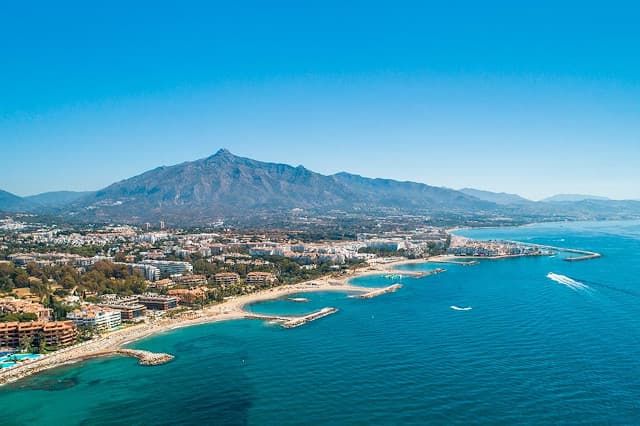
Estepona has around twenty-one kilometres of coastline, and the coastal boardwalk now runs along a substantial stretch of it, connecting beaches, the port and the town centre in a continuous walking and cycling route. It is the single most-used piece of infrastructure the town has built, and it changed the way the seafront functions.
The Paseo Marítimo through the centre was rebuilt alongside it, with the Mirador del Carmen and a run of beachfront restaurants. Playa de la Rada is the main town beach; further west the coves become quieter, and to the east the beaches run past Laguna Village towards Cancelada. For property, proximity to the boardwalk has become a genuine pricing factor, in the same way frontline golf is inland.
The Port and Marina
Estepona's port is a working one, and that is its charm. Fishing boats unload alongside pleasure craft, the fish market operates each morning, and the restaurants around it serve what came in that day rather than what a supplier delivered. The marina has a sailing club, a dive centre and a Sunday market.
It is also one of the town's stronger rental micro-markets, for the obvious reason that visitors want to be able to walk to dinner.
The New Golden Mile
East of the town, running along the A-7 towards Marbella, lies the stretch that has attracted most of the investment capital: the New Golden Mile, taking in Cancelada, Selwo, El Paraíso and Atalaya.
The name references Marbella's original, and the comparison is fair on quality without being fair on character. Most of the housing dates from the late 1990s onwards, so the stock is contemporary rather than historic: large beachfront developments, gated villa estates and resort-style communities with pools, gyms, concierge and spa facilities. Density is lower than Marbella's coast road, through-traffic is lighter, and there are more year-round residents than summer visitors.
It is calmer than Marbella's Golden Mile and considerably cheaper, while being fifteen minutes from Puerto Banús. That combination is why so many buyers who arrive intending to purchase in Marbella end up here once they compare what their budget actually delivers. Hotels including Ikos Andalusia and Kempinski Bahía, plus Laguna Village and Selwo, give the stretch a resort infrastructure of its own.
West Estepona and the Golf Belt
West of the town, towards Casares and Manilva, is where experienced buyers have been finding the most realistic long-term value. It was once dismissed on distance, which is no longer a serious objection: the road is good, the airport is under an hour, and Gibraltar is closer than Málaga.
What it offers is space, modern construction and low density without moving inland. Inland of both ends of the town sits a substantial golf belt — Estepona Golf, Valle Romano, Azata, La Resina and Doña Julia among them — with Sierra Bermeja and the peak of Los Reales behind, which is why so much of Estepona feels green rather than built up.
What It Costs
Estepona averages in the region of 4,290 euros per square metre as of mid-2026, having risen approximately 11.6 per cent year on year, with some indices putting houses slightly higher at around 4,335. Marbella's Golden Mile, for comparison, sits near 6,790.
The range within the municipality is wide. Central apartments can still be found from the mid-200,000s; a two-bedroom apartment averages around 320,000; New Golden Mile properties typically exceed 500,000; and premium villas and frontline golf positions run from 5,000 to 8,000 euros per square metre, with the best new build now above 7,000. Notarial figures showed completed prices in Estepona up 19.2 per cent in the first half of 2026, the strongest of the three Golden Triangle municipalities.
New build accounts for roughly a quarter of transactions here, against about 11 per cent in Marbella — a direct consequence of Estepona having the development land its neighbour lacks. Foreign buyers represent around 68 per cent of purchases.
The Investment Case
Three things underpin it. The price gap with Marbella remains wide enough to matter while the quality gap has narrowed considerably — that convergence is the whole thesis. The supply of new build is genuine but finite, since Estepona is not unlimited land either. And the civic investment is permanent, which puts a floor under the town's desirability in a way that a single development never can.
On returns, median gross rental yields sit near 5.8 per cent, with the old town, the port and the New Golden Mile at the stronger end, though yields vary enormously by property and district. Capital appreciation has been the dominant return driver, running between 8 and 12 per cent annually since 2021. Anyone modelling the future should plan on 5 to 7 per cent as the more realistic long-term figure, since rents have been broadly flat while prices have climbed, which compresses yield for buyers entering now.
Conclusion
Estepona has stopped being the affordable alternative and become a destination in its own right. It kept a Spanish old town while building a modern seafront, added parks, art and infrastructure at public expense, and then let the private market respond.
For buyers, the practical question is no longer whether Estepona is worth considering but which Estepona — the historic centre, the boardwalk, the New Golden Mile or the quieter west. Each is a different purchase, and the town is now large and varied enough that getting that choice right matters as much as the price you pay.